

A girl, four years old, is sitting on the floor building a tower of cups. It drops. She laughs, makes it a little wider and tries again. Nobody told her to practice planning or patience or problem-solving, but that’s exactly what she’s doing.
Play is how young children learn to think, and the right games for cognitive development can make that natural learning more purposeful. In this blog, we look at what cognitive skills are, how interactive play builds them, and how parents and teachers can use games every day, with or without therapy support.
What Is Early Childhood Cognitive Development?
Early childhood cognitive development is how a child learns to notice, remember, understand, and solve problems. It includes:
- Attention: staying focused on a task
- Memory: holding on to and recalling information
- Reasoning: understanding cause and effect and “what comes next”
- Problem-solving: trying, adjusting, and trying again
- Flexible thinking: switching between ideas or rules
They are closely related to behavior and language. Children who can pay attention and remember what they’ve been told find it easier to learn new words, keep up with routines in the classroom, and engage in discussions. The first few years are the most important since the brain develops rapidly and daily experiences shape how these skills develop.
What are games used for in cognitive development?
Cognitive games are organized play activities that work out one or more thinking skills. They can be as simple as a card matching game or as complex as a building challenge. They can also be called cognitive development games, cognitive ability games or cognitive games for kids. The thought is the same. A child learns to think while he is having a good time.
It’s the back and forth that makes a game interactive. The child does, sees a result, and adjusts. Interactive learning games for kids are powerful because of that instant feedback.
Why Games Are Better Than Worksheets for Cognitive Development
Worksheets have their place, but young children get bored easily. Games help in three ways:
- Children stay engaged, so they practise for longer.
- Repetition feels natural. A game a child loves can be played again and again without it feeling like a drill.
- Mistakes feel safe. A wrong move is just part of playing, so pressure stays low and confidence stays high.
How Interactive Learning Games Build Thinking Skills
Different games work on different skills. Here is a simple guide:
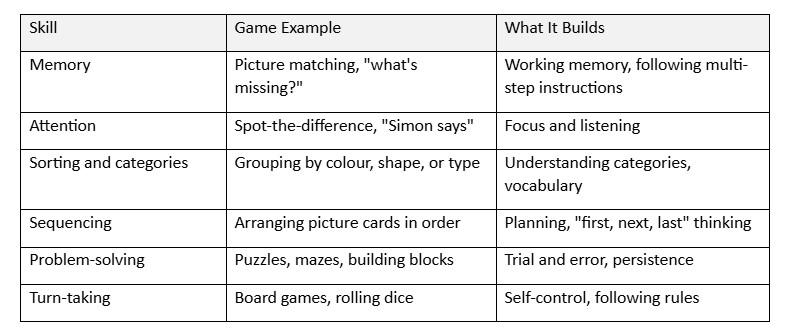
Special mention to problem solving games for kids. A child needs to stop and think again, when a puzzle piece doesn’t fit, and try another way. That little moment of “that didn’t work, what else can I try?” is the basis for flexible thinking.
How Cognitive Games Help Speech and Language Development
Thoughts and language develop together. One has to learn the categories before one can name them , and learn sequences before one can tell a story or build a sentence.
- A category game (fruits, animals, vehicles) builds both reasoning and vocabulary.
- A sequencing game supports sentence structure and storytelling.
- A problem-solving game encourages words like “because”, “why”, and “what if”.
This is why many speech therapy activities are based on games. A memory match game can be used to practice vocabulary and a sorting game can teach descriptive language at the same time. Often the games we use for cognitive development and speech and language goals go hand in hand.
Using Games Between Therapy Sessions
Children in speech therapy typically have sessions a few times a week for a few hours. The difference for the rest of the week is consistent practice, and games are an easy way to bring therapy goals into daily life.
A parent can:
- Play for 10 to 15 min a fixed time each day
- Select games that are in line with the goals of the child’s therapist
- Ask questions during play (“What comes next?”, “Which one does not belong?”)
- Keep it lighthearted so practice never feels like a test
Online or in Print? Selecting the Appropriate Format
Both are correct.
Digital cognitive games and online speech therapy games are convenient, available any time, suitable for teletherapy, and they save the work of printing and laminating. Printable and hands-on games add eye contact, real conversation, and screen-free playtime.
If you want ready-to-use, picture-based materials, Walnut Early Supports is a digital library of 4,500+ materials created by certified speech-language pathologists. It covers cognition along with language, speech sounds, and social-emotional skills, with visuals designed for Indian children. It works in the browser, so there is nothing to download or print. It gives parents, teachers, and therapists ready-made speech therapy game resources, while the therapy itself still needs a qualified professional guiding the process.
How to Choose the Right Games for Cognitive Development
Not every game labelled “educational” supports learning. Look for games that are:
- Right for the child’s age and level. Too easy gets boring, too hard gets frustrating.
- Clear and picture-based. Simple visuals help children understand the task and suit multilingual homes.
- Repeatable. Children benefit from practising the same skill in many ways.
- Interactive with an adult. The best learning happens when someone plays along and talks about the game.
Tips for Parents and Teachers
- Keep sessions short. Ten focused minutes are better than an hour of tired play.
- Praise effort, not just correct answers.
- Practice at the same time each day so it becomes a habit.
- Follow your child’s lead. If they love a game, use it to teach more skills.
- In class, use matching, sorting, and sequencing games in small groups. They help the whole class, not just children with identified needs.
- Share what you notice with the child’s therapist so everyone works toward the same goals.
When to Seek Professional Support
Games and home practice go a long way, but consider an evaluation if your child:
- Struggles to focus even during favourite activities
- Gets overwhelmed by simple two-step instructions
- Shows little progress despite regular practice
- Has delayed speech or language for their age
Early support gives children more options before school demands increase.
Frequently Asked Questions
Q1. What age can kids start playing games for cognitive development?
Simple games such as peekaboo, stacking and matching may begin in toddlerhood. As the child grows, the games become more complex. What matters most is that the game matches the age and current level of the child.
Q2. How often should my child play these games?
Short, frequent sessions work best. For most young children a good start is about 10 to 15 minutes a day. Follow your child’s focus and mood.
Q3. Can educational games take the place of therapy?
No. Games offer additional practice and help with learning, but they are not a replacement for assessment or therapy by a qualified professional. Think of them as a reinforcement of what is learned in the sessions.
Q4. Are virtual games as good as physical ones?
Both can assist in cognitive skills . The best choice will depend on your child’s age, attention span, and your family’s routine. The biggest difference between either format is an adult that plays along and talks with the child.
Q5. How can I tell if a game is right for my child’s level?
A good game is hard but possible. If your child gets easily annoyed, try an easier level. If they finish everything with no effort, move on to a harder one.
Conclusion
Children don’t need complicated tools to build thinking skills. They need play that is repeatable, slightly challenging, and shared with someone who cares. Chosen well and played regularly, games for cognitive development can support memory, attention, reasoning, and language, both at home and alongside therapy. A few minutes of play each day, done consistently, can go a long way.