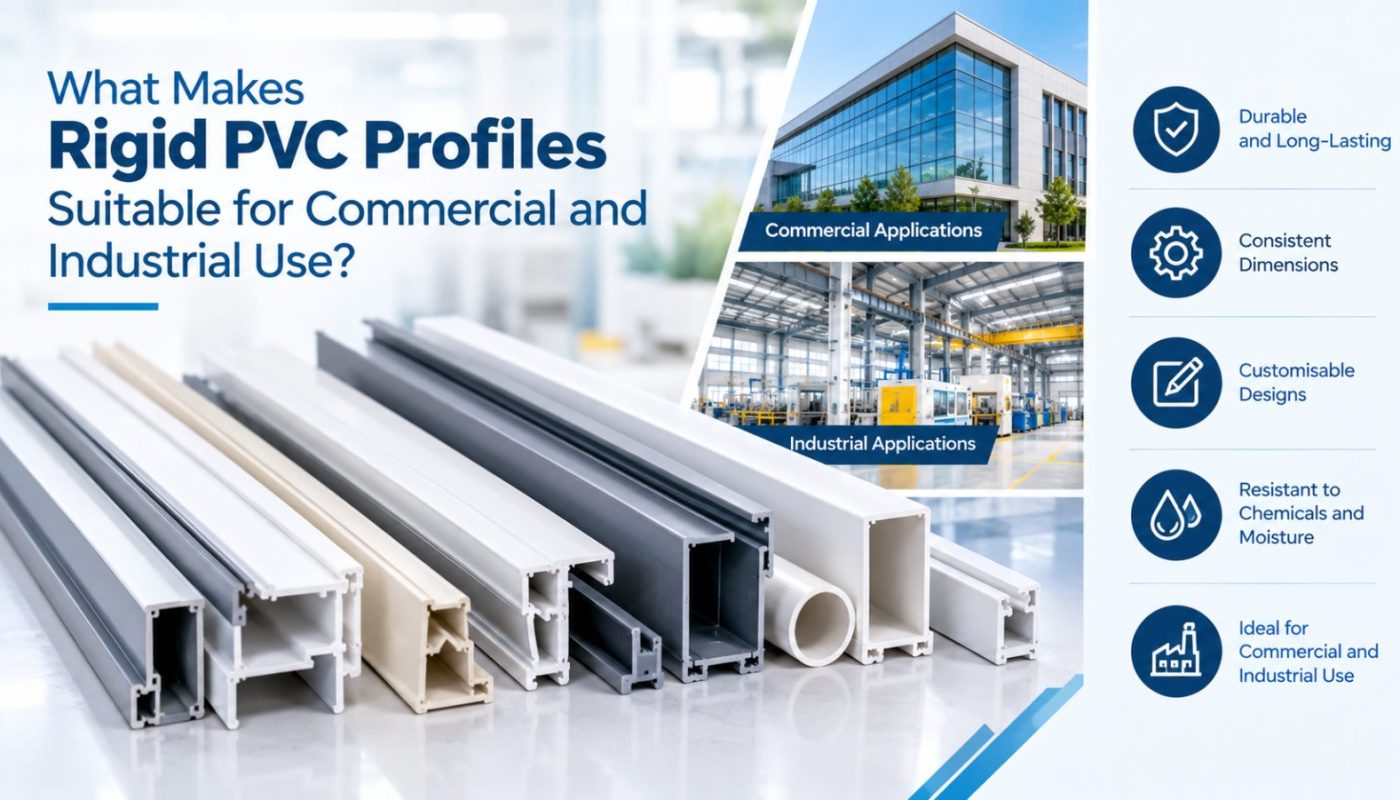
Rigid PVC profiles are widely used in commercial and industrial applications because they can be manufactured in different shapes, sizes and designs to meet specific product requirements. They offer a practical option for manufacturers that need profiles with consistent dimensions, suitable rigidity and reliable performance in their intended applications. The right profile depends on the material requirements, operating conditions and design of the finished product.
In this article, we explain what makes rigid PVC profiles suitable for industrial and commercial use, where they can be applied, and what businesses should consider when selecting profiles for their products.
What Are Rigid PVC Profiles?
Rigid PVC profiles are shaped plastic components made from rigid polyvinyl chloride (PVC). They are produced through an extrusion process in which PVC material passes through a specially designed die to create a continuous profile with a specific cross-section.
Unlike flexible PVC profiles, rigid PVC profiles are designed to retain their shape under normal conditions of use. Their dimensions, wall thickness, shape and material formulation can be selected according to the intended application.
Manufacturers use these profiles in products that require a defined shape, a stable structure and consistent dimensions. Depending on the design and material formulation, rigid PVC profiles can serve a range of commercial and industrial purposes.
Why Are Rigid PVC Profiles Suitable for Industrial Applications?
Rigid PVC profiles offer several practical features that make them useful for industrial production. Their suitability depends on the application, profile design and required performance.
1. They Can Be Made to Specific Designs
Industrial products often need components that fit a particular assembly or design. Standard profiles may not meet every requirement, especially when a product has unique dimensions or a specialised cross-section.
Rigid PVC extrusion allows manufacturers to produce profiles in different shapes and sizes. Businesses can provide technical drawings, dimensions and specifications to help define the profile design.
This makes rigid PVC profiles for industrial applications useful when a manufacturer needs a component that fits its own product design.
2. They Support Consistent Production
Consistency matters when businesses manufacture products in large quantities. Profiles with changing dimensions can cause fitting problems, assembly delays and unnecessary material waste.
A properly developed extrusion process helps maintain consistent profile dimensions during production. Tooling design, material selection, process settings and quality checks all contribute to the final result.
For businesses that require repeated production runs, these factors are important when selecting a rigid PVC profile manufacturer.
3. They Offer Design Flexibility
Rigid PVC profiles can be manufactured with different cross-sectional shapes to suit specific product requirements. The design may include channels, grooves, edges or other features needed for fitting and assembly.
For example, a manufacturer may need a profile that fits into a particular housing or supports the assembly of several product components. Custom extrusion can help meet these requirements without forcing the product design to rely on an unsuitable standard shape.
The final design should be assessed against the intended use, dimensional tolerances and material requirements.
4. They Can Suit Different Commercial Requirements
Commercial products may require profiles that fit a defined appearance, size or assembly method. Rigid PVC profiles can be produced according to these requirements, subject to the selected material and extrusion design.
Businesses may specify profile dimensions, colour and surface requirements when these options are suitable for the product. The required features should be confirmed during the design and sampling stage.
This flexibility can help manufacturers source profiles that match their product specifications rather than adapting their products around a standard component.
5. They Can Support Bulk Manufacturing
Businesses that manufacture products in large quantities need a dependable supply of components. Custom rigid PVC profiles can be developed for repeat production when the design, tooling and material specifications have been established.
Before starting bulk production, manufacturers should confirm the profile drawing, sample approval, order quantity, quality requirements and delivery schedule.
These checks help reduce the risk of receiving profiles that do not match the intended application.
Where Are Rigid PVC Profiles Used?
Rigid PVC profiles can be used across a range of commercial and industrial applications. The exact use depends on the profile shape, material formulation and performance requirements.
Common application areas may include:
- Industrial equipment and assemblies. Custom profiles can be designed to fit specific components or support product assembly.
- Commercial products. Profiles can be made to meet the dimensions and design requirements of commercial products.
- Building and construction components. Suitable rigid PVC profiles may be used in selected applications where their material properties meet the project requirements.
- Electrical and technical components. Custom profiles may be considered for suitable applications when the required insulation, dimensional and safety specifications are met.
- Product housings and fittings. Extruded profiles can provide shaped components for products that require a defined cross-section.
Not every rigid PVC formulation is suitable for every application. Businesses should check the required strength, temperature range, chemical exposure, fire performance and applicable industry standards before choosing a material.
What Should Businesses Check Before Choosing Rigid PVC Profiles?
Selecting the right profile involves more than comparing shapes or dimensions. Businesses should consider the full set of product requirements before placing a production order.
Profile Dimensions and Tolerances
Prepare a technical drawing that includes the cross-section, overall dimensions, wall thickness and critical fitting points. Define acceptable dimensional tolerances so the manufacturer can assess whether the profile can be produced to the required specification.
Material Requirements
Confirm the properties needed for the application. These may include rigidity, impact resistance, temperature performance, chemical resistance and outdoor exposure requirements.
Do not assume that every rigid PVC profile offers the same performance. Material formulation and product design can affect the result.
Operating Conditions
Explain where and how the profile will be used. A component intended for indoor use may have different requirements from one exposed to sunlight, moisture, heat or industrial chemicals.
Sample Approval
Review a sample before approving bulk production. Check the dimensions, shape, colour, fit and other agreed specifications against the technical drawing.
Sample approval gives both the buyer and manufacturer a clear reference for the production order.
Production Capacity and Lead Time
Ask the manufacturer to confirm whether it can meet the required quantity, quality checks and delivery schedule. For repeat orders, agree on the approved specifications and any changes that require further confirmation.
These discussions are especially important when sourcing rigid PVC extrusion for industrial components, where the profile must match the finished product’s design and assembly requirements.
Custom Rigid PVC Profiles or Standard Profiles: Which Is Better?
The choice depends on the product design and production requirements.
| Factor | Standard profiles | Custom rigid PVC profiles |
| Design | Available in established shapes and dimensions | Developed around specified design requirements |
| Fit | Suitable when standard dimensions meet the application | Useful when the product needs a specific cross-section |
| Development | May require less design work | May require drawing review, tooling and sample approval |
| Production | Depends on available sizes and supply | Can be planned around agreed specifications and order quantities |
| Best suited for | Applications that accept standard dimensions | Products that need a particular shape or dimensional arrangement |
A standard profile may be suitable when it already meets the technical requirements. A custom profile may be a better option when the product needs a particular cross-section, fit or set of dimensions.
The decision should be based on technical suitability, production volume, development requirements and overall project cost.
How Does M3 Extrusion Help Businesses Source Rigid PVC Profiles?
M3 Extrusion is an Indian manufacturer of customised plastic extrusion profiles for industrial and commercial applications. The company works with B2B customers that require profiles manufactured according to their drawings, dimensions, material requirements and bulk production needs.
For businesses sourcing rigid PVC profiles, the process begins with understanding the intended application and reviewing the required profile design. Samples can be produced for assessment before bulk production, helping customers check whether the profile meets their specifications.
M3 Extrusion also supports OEM manufacturing and international supply. Buyers should share their technical drawings, estimated quantities, material requirements and inspection needs to help determine the production requirements for their project.
Businesses looking for rigid PVC extrusion profiles for Indian industries can also review the considerations covered in this related article: 7 Benefits of Rigid PVC Extrusion Profiles for Indian Industrial Applications.
Frequently Asked Questions
1. What are rigid PVC profiles used for?
Rigid PVC profiles are used in commercial products, industrial assemblies, building components and other applications that require a defined plastic shape. Their suitability depends on the design, material formulation and operating conditions.
2. Can rigid PVC profiles be manufactured to custom dimensions?
Yes. Custom rigid PVC profiles can be produced according to agreed drawings, dimensions and specifications, provided the design is suitable for the extrusion process.
3. Are rigid PVC profiles suitable for outdoor use?
Some rigid PVC formulations can be suitable for outdoor applications, but performance depends on the material formulation, exposure conditions and required service life. Buyers should confirm UV resistance, temperature limits and other relevant requirements with the manufacturer.
4. What information should I provide when requesting a custom PVC profile?
Provide a technical drawing, cross-sectional dimensions, material requirements, colour specifications if applicable, estimated order quantity and details of the intended application. Also explain any critical tolerances or performance standards.
5. Should I approve a sample before bulk production?
Yes. Reviewing a sample helps confirm the dimensions, shape, fit and other agreed requirements before a larger quantity is manufactured.
6. How do I choose a rigid PVC profile manufacturer?
Look for a manufacturer that can review technical drawings, understand the intended application, discuss material requirements, support sample approval and explain production and delivery arrangements. Clear specifications and communication help reduce problems during bulk manufacturing.
Summary
Rigid PVC profiles are suitable for many commercial and industrial applications because they can be extruded into specific shapes and dimensions. Their design flexibility, potential for consistent production and suitability for customised manufacturing make them a practical option for businesses with defined component requirements.
However, the right choice depends on the material formulation, operating conditions, dimensional tolerances and intended use. Reviewing drawings, checking material requirements and approving samples before bulk production can help businesses make a better-informed decision.
If your business needs customised rigid PVC profiles, contact M3 Extrusion to discuss your drawings, specifications and production requirements. The team can help assess your requirements for sample development and bulk manufacturing.